Making bread, pizza, and sourdough by hand can be rewarding, but mixing and kneading become tiring when you bake often or work with larger batches. The best electric dough kneading machines automate much of that effort while helping produce more consistent dough.
This roundup compares 10 options ranging from compact home dough makers to high-capacity commercial mixers. We focus on bowl size, motor power, fermentation controls, attachments, cleaning, and the type of baker each machine suits best.
Best 10 Electric Dough Kneading Machines Picks for 2026
Best Commercial Capacity Pick
55-LB Stainless Steel Dough Mixer

- 25-kilogram batch capacity
- 2,200W motor with forward/reverse rotation
- 90-degree tilting stainless steel barrel
Best For: High-volume restaurant and food-service production
Best Versatile Fermentation Pick

- 9.5-quart capacity for larger home batches
- Four modes for dough, proofing, and fillings
- Winter and summer fermentation settings
Best For: Home cooks needing versatile dough and filling preparation
Best Straightforward Family Pick

- Kneads and ferments in one appliance
- Handles up to 1,600 grams of flour
- Detachable chute for adding ingredients
Best For: Families preparing regular home baking batches
Best Commercial Heavy-Duty Pick

- 50-liter commercial capacity with a 304 stainless steel bowl
- Dual rotation and two speeds for consistent high-volume mixing
- Safety-cover shutoff plus manual emergency-stop switch
Best For: Commercial kitchens, bakeries, and high-volume dough production
Best Family-Size Home Pick

- 7.4-quart capacity for larger homemade dough batches
- Combines intermittent kneading and fermentation in one bowl
- 304 stainless steel bowl with suction feet for stability
Best For: Families and frequent home bakers making larger batches
Best Integrated Fermentation Pick
DoughChief 7.4-Quart Dough Mixer
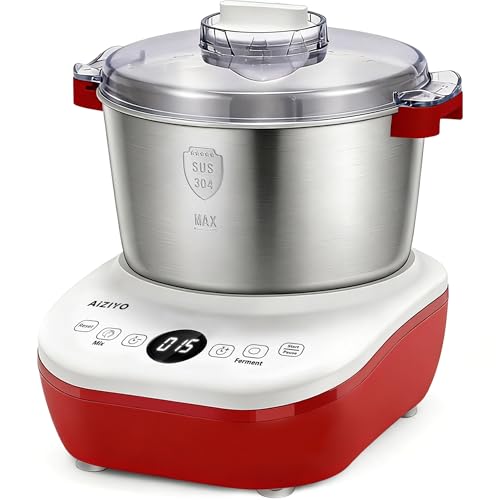
- Mixes and ferments dough in one appliance
- Large 7.4-quart stainless steel bowl
- Touch controls and ingredient-addition opening
Best For: Home bakers who want large-batch mixing with built-in proofing
Best Control and Stability Pick

- Handles 300–1,400 grams of dough
- Includes timed kneading and fermentation
- Knob controls and suction-cup stability
Best For: Bakers who prefer tactile controls and versatile batch sizes
Best Smart Home Baker Pick – Joydeem JD-HMJ7L Dough Maker
For home bakers comparing electric dough kneading machines, the Joydeem JD-HMJ7L combines timed mixing with fermentation in a compact vertical design. Its 6.6-quart capacity and 250W motor are suited to everyday batches of bread, pizza, buns, and dumplings.
Best For: Families wanting preset kneading and proofing with minimal hands-on work.
Pros:
- Microcomputer controls support time presets and automatic kneading or fermentation programs.
- Stainless steel bowl and blade are dishwasher safe.
- Face-up controls, suction cups, and a weighted body help save space and reduce movement.
- Can knead dough in about 15 minutes or knead and proof in about 45 minutes.
Cons:
- It has one speed and a listed noise level of 70 dB.
- The 6.6-quart capacity is smaller than commercial models.
- The base is not dishwasher safe.
The JD-HMJ7L is a practical choice when convenience matters more than speed customization. Its automatic fermentation function and removable top make it especially useful for routine family baking.
Best Commercial Capacity Pick – 55-LB Stainless Steel Dough Mixer
This 55-pound commercial mixer stands out among electric dough kneading machines for restaurants and other high-volume kitchens. Its 2,200W motor, stainless steel construction, forward/reverse paddle, and tilting bowl are designed for large batches of dough and fillings.
Best For: Restaurants, noodle shops, canteens, and other food-service operations handling peak-hour production.
Pros:
- Handles up to 55 pounds or 25 kilograms of dough per batch.
- Food-grade stainless steel construction is durable and easy to clean.
- Forward and reverse rotation supports kneading and easier dough release.
- 90-degree tilting barrel simplifies unloading and rinsing.
Cons:
- At 156.5 pounds, it is heavy and intended for a permanent commercial setup.
- The machine is large, measuring about 24 by 31 by 29 inches.
- The manufacturer notes that it is not suitable for bread or pizza.
This is a production-focused mixer rather than a home appliance. The large capacity and tilting design can improve workflow for buns, dumplings, noodles, and fillings, provided you have the space and electrical setup.
Best Versatile Fermentation Pick – Joydeem HMJ-A901 Dough Maker
The Joydeem HMJ-A901 is one of the more flexible electric dough kneading machines for households that make both dough and fillings. Its 9.5-quart bowl, adjustable mixing and fermentation times, and separate Mix and Blend functions cover bread, pizza, sourdough, roti, dumplings, and steamed buns.
Best For: Home cooks who want one appliance for dough kneading, proofing, and continuous filling mixing.
Pros:
- Supports four modes: Mix, Ferment, Mix + Ferment, and Blend.
- Offers seasonal fermentation modes with adjustable proofing times from 5 to 120 minutes.
- Large 9.5-quart capacity accommodates up to 2,800 grams of flour, with a 2,500-gram fermented-dough limit.
- 304 stainless steel bowl and blade are durable and easy to clean.
Cons:
- The recommended flour-to-water ratio and capacity limits still require careful batch planning.
- Its larger footprint may be less convenient for small kitchens.
- The 300W motor is intended for household use, not commercial-scale production.
Choose the HMJ-A901 if flexibility is a priority. Its independent fermentation settings and filling-mixing mode make it more versatile than a basic kneader, especially for varied home cooking.
Best Straightforward Family Pick – VEVOR 6.9-Quart Dough Maker
For shoppers seeking straightforward electric dough kneading machines, the VEVOR 6.9-quart model combines continuous mixing with constant-temperature fermentation. Its 250W motor and 6.5-liter stainless steel bowl are sized for family batches of bread, pizza, pasta, sourdough, buns, and dumpling wrappers.
Best For: Families wanting a simple kneading-and-proofing appliance for regular home baking.
Pros:
- Handles up to 1,600 grams of flour for batches serving larger families.
- Kneading and fermentation are combined in one machine.
- Detachable ingredient chute allows additions without stopping the mixer.
- Digital controls provide convenient operating-time settings.
Cons:
- The 250W motor is less powerful than the commercial model in this roundup.
- It offers a single listed mixing speed rather than speed customization.
- Its capacity is smaller than the 9.5-quart Joydeem model.
The VEVOR is a balanced home-use option for buyers who want uncomplicated operation and built-in proofing. It offers useful capacity without the size and weight of a commercial mixer.
Best Seasonal Fermentation Pick – Joydeem 3.7Qt Electric Dough Maker
The Joydeem HMJ-A351 is a practical choice among electric dough kneading machines for home bakers who want timed kneading and built-in proofing. Its intermittent 150W kneading action handles bread, pizza, pasta, sourdough, roti, dumplings, and steamed-bun dough, while dedicated seasonal fermentation modes help maintain a suitable temperature year-round.
Best For: Home bakers who want a compact dough maker with adjustable kneading and seasonal fermentation settings.
Pros:
- Supports mixing, fermentation, or combined mixing-and-fermentation programs.
- Summer and Winter fermentation modes offer adjustable time ranges and temperature control.
- 304 stainless steel bowl and blade are durable and easier to clean.
- Suction feet help improve stability and reduce operating noise.
Cons:
- The 3.7-quart capacity is smaller than commercial models and is limited to 900g of flour for fermented dough.
- Its kneading motion is intermittent and the speed is not adjustable.
Choose this model if consistent proofing is as important to you as kneading. The timed controls and stainless steel components make it versatile for regular home baking, though larger households may prefer a higher-capacity machine.
Best Commercial Heavy-Duty Pick – 50L Dual-Rotation Dough Mixer
This 50L commercial mixer is one of the electric dough kneading machines suited to high-volume food preparation. Its dual-rotation design turns both the spiral hook and bowl, while two speeds support gentler mixing or more efficient kneading for bread, pizza, glutinous rice mixtures, and vegetable purees.
Best For: Bakeries, pizzerias, restaurants, caterers, and institutional kitchens producing large batches.
Pros:
- Large 50-liter listed capacity with a food-grade 304 stainless steel bowl.
- Dual rotation is designed to improve mixing consistency.
- Two speed settings accommodate different dough textures and recipes.
- Safety cover shutoff and manual emergency stop support commercial operation.
Cons:
- Its 16-by-32-by-39-inch footprint is substantial for a home kitchen.
- The 2,200W motor and 110V electrical requirement are geared toward commercial use.
- It offers only two speeds rather than continuously adjustable speed control.
This mixer makes the most sense where throughput, bowl capacity, and safety features outweigh portability. For occasional home baking, its size and commercial power may be more machine than necessary.
Best Family-Size Home Pick – 7.4Qt Electric Dough Maker
The 7.4Qt Electric Dough Maker offers a larger home-baking capacity without the footprint of a commercial mixer. As one of the more flexible electric dough kneading machines for families, it combines intermittent kneading with fermentation in one stainless steel bowl for bread, pizza, sourdough, rolls, and dumplings.
Best For: Families and frequent home bakers making larger batches with less manual kneading and cleanup.
Pros:
- 7.4-quart capacity is designed for family-size dough batches.
- Combines kneading and fermentation in the same bowl.
- Intermittent kneading allows dough to rest and may help limit heat buildup.
- 304 stainless steel bowl and suction feet support easier cleanup and stable operation.
Cons:
- The supplied details specify a 250W motor but do not list adjustable speeds or kneading time ranges.
- It is larger than a compact dough maker, despite remaining intended for home use.
This model is a strong middle ground for households that regularly prepare larger dough batches. Its integrated fermentation and stable kneading setup reduce handling, but shoppers wanting detailed speed or timer control may need to verify those features before buying.
Best Integrated Fermentation Pick – DoughChief 7.4-Quart Dough Mixer
The AIZIYO DoughChief is one of the more versatile electric dough kneading machines for home bakers who want mixing and proofing in one appliance. Its 7.4-quart stainless steel bowl, S-shaped blade, and constant-temperature ferment setting are suited to bread, pizza, and pasta dough.
Best For: Home bakers and families who want a large-capacity mixer with built-in dough fermentation.
Pros:
- Combines mixing and 77–100°F fermentation in one machine.
- 7.4-quart 304 stainless steel bowl supports larger batches.
- Wide top opening allows ingredients to be added during mixing.
- Touch controls, digital display, timer setting, and low-noise design add convenience.
Cons:
- With one listed speed, it offers less speed control than conventional stand mixers.
- The 75 dB noise rating may still be noticeable in a quiet kitchen.
- The fermentation function requires yeast or fermentation powder.
The DoughChief stands out when proofing convenience matters as much as kneading. Its large bowl and straightforward automated program make it a practical choice for repeat bread and pizza batches, though shoppers seeking multiple mixing speeds may prefer another design.
Best Control and Stability Pick – 6.5-Quart Dough Maker
This 6.5-quart electric dough kneading machine combines a hand-kneading-style mix-pause-mix program with constant-temperature fermentation. It is designed for batches from 300 to 1,400 grams of dough and uses a knob control, suction-cup base, and removable components for practical everyday use.
Best For: Bakers who want mechanical controls, stable operation, and a generous batch range for bread, pizza, dumplings, and pastries.
Pros:
- 6.5-quart 304 stainless steel bowl handles 300–1,400 grams of dough.
- S-shaped blade and timed mix-pause-mix cycle support even gluten development.
- 77–95°F constant-temperature fermentation is built in.
- Knob controls, suction-cup feet, lid buckles, and low-noise construction support convenient operation.
Cons:
- The supplied notes do not specify the motor wattage or full dimensions.
- The bowl is not recommended for dishwasher cleaning, although the dough blade can be washed there.
- Fermentation requires yeast or baking powder.
This model is a strong fit for users who prefer tactile knob controls and want the machine to remain steady while kneading. Its wide dough range and fermentation mode add flexibility, while the removable blade simplifies cleanup.
Best Compact Family-Batch Pick – 5.3-Quart Dough Mixer
The 5.3-quart dough mixer is a compact option among electric dough kneading machines, with a 250-watt motor and automatic fermentation after kneading. Its transparent lid, top feeding window, and touch panel make it easy to monitor and adjust everyday bread, pizza, dumpling, cookie, and cake preparations.
Best For: Families seeking a smaller countertop dough maker that can prepare up to three loaves in a batch.
Pros:
- 5.3-quart capacity handles 300–1,600 grams of flour and up to three loaves.
- Automatic 77–100°F fermentation begins after kneading.
- Transparent lid and top window make monitoring and adding ingredients convenient.
- Silicone noise-reduction pad supports quieter operation.
Cons:
- For best fermentation results, the notes recommend no more than 1,300 grams of flour.
- The 250-watt motor may be less powerful on paper than some larger dough machines.
- Touch controls may be less convenient than knobs when hands are covered in flour.
This mixer balances family-sized capacity with a relatively compact footprint and straightforward automatic proofing. It is particularly appealing for varied home baking, provided users stay within the recommended flour amount for fermentation.
How We Picked the Best Electric Dough Kneading Machines
We evaluated these machines around the practical tasks buyers care about most: mixing dough evenly, handling realistic batch sizes, supporting fermentation, and fitting comfortably into a home or commercial workflow. Capacity, construction, controls, motor output, bowl design, and included functions all influence how useful a machine will be beyond its product listing.
We also separated compact household models from commercial mixers. A large-capacity machine may be more productive, but it can require more counter space, electrical capacity, and cleanup. Conversely, a smaller model may be easier to store but less suitable for repeated heavy batches.
Quick Comparison
| Best For | Look For | Typical Options in This Roundup |
|---|---|---|
| Everyday home baking | About 3.7 to 7.4 quarts, simple controls, removable parts | Compact and mid-size Joydeem, VEVOR, AIZIYO, and similar models |
| Large family batches | About 7.4 to 9.5 quarts, stronger drive system, fermentation mode | Large-capacity electric dough makers |
| Bakery or restaurant production | 50- to 55-pound capacity, high wattage, commercial spiral hook | 110V commercial dough mixers |
| Fermented dough recipes | Seasonal or temperature-timed fermentation controls | Models with winter/summer or programmable ferment functions |
Key Buying Factors for Electric Dough Kneading Machines
Capacity and Batch Size
Choose capacity based on the amount of flour and dough you regularly prepare, not the bowl’s advertised volume alone. A machine that is too small may strain during heavy kneading, while an oversized commercial mixer can be inefficient for a single loaf.
Motor Power and Mixing Action
Wattage provides a useful reference, but it does not tell the whole story. Drive construction, spiral-hook design, dual rotation, and speed control affect how effectively a machine handles stiff bread or pizza dough. Commercial models are better suited to frequent, demanding batches.
Fermentation Controls
Fermentation functions can maintain a more suitable environment for yeast dough, especially in colder kitchens. Look for clear timing controls and a design that makes it easy to monitor or remove the dough. These features are helpful, but they do not replace recipe-specific proofing judgment.
Controls, Bowl, and Cleanup
Touch panels and microcomputer controls can simplify timed programs, while removable lids and stainless steel bowls make routine cleaning easier. Check whether hooks, lids, and other food-contact parts are removable and whether replacement accessories are available.
Space and Electrical Requirements
Measure your counter and storage area before buying. Commercial 110V machines still need substantial room and may be heavy to move. Confirm the outlet, cord arrangement, ventilation, and operating environment required by the model.
Who Should Buy Which Electric Dough Kneading Machines?
Occasional home bakers should prioritize a compact machine with straightforward controls and manageable cleanup. Frequent bread and pizza bakers will likely benefit from a 6.5- to 9.5-quart model with a stronger motor and fermentation programming. Sourdough users should favor precise timing and a removable or easy-to-clean bowl. Small bakeries, restaurants, and high-volume kitchens should focus on commercial capacity, durable mixing components, dual-speed operation, and stable placement rather than household convenience features.
Before ordering, confirm the machine’s maximum recommended dough load, included attachments, dimensions, warranty, and return policy. Those details often matter more than a larger advertised bowl or a higher headline wattage.