A reliable chest freezer can add valuable food storage without taking over your kitchen. For a basement, the best choice balances capacity, noise, energy use, temperature control, and access around the lid.
We compared 10 compact and mid-size models ranging from approximately 2.7 to 7.1 cubic feet, highlighting which features matter most for household overflow, meal prep, bulk shopping, and backup storage.
Best 10 Chest Freezer for Basement Picks for 2026
Best Compact Pick
DEMULLER 3.5 Cu. Ft. Digital Chest Freezer

- Precise digital control accurate to 1°F
- Two removable wire storage baskets
- Compact 3.5-cu.-ft. freestanding design
Best For: Small households needing organized basement storage
Best Convertible Pick
Midea 3.5 Cu. Ft. Convertible Chest Freezer

- Switches between freezer and fridge modes
- Designed for non-climate-controlled spaces
- Provides up to 48 hours of outage protection
Best For: Flexible secondary storage in a basement or garage
Quietest Compact Pick
Bodacious 5.0 Cu. Ft. Ultra Quiet Freezer
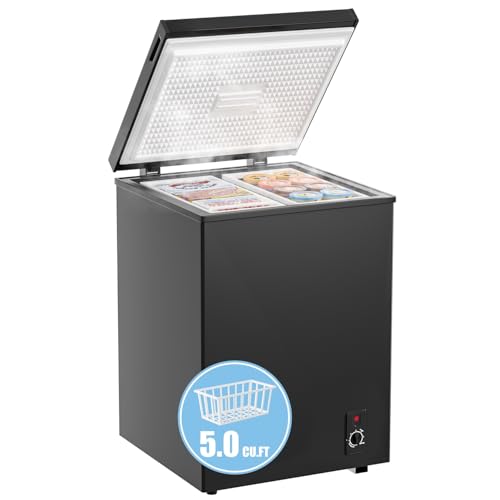
- Quiet operation below 40 dB
- Fast-freeze function for fresh foods
- 5.0 cu. ft. capacity in a compact footprint
Best For: Noise-sensitive basement and indoor placements
Best Bulk-Storage Pick
BANGSON 7.1 Cu. Ft. Chest Freezer

- Largest 7.1-cu.-ft. storage capacity here
- Seven-level adjustable temperature control
- Removable basket and quiet operation
Best For: Families and bulk shoppers with basement floor space
Large-Capacity Pick
Frigidaire 7 Cu. Ft. Chest Freezer

- 7 cu. ft. capacity for bulk storage
- Seven-setting adjustable thermostat
- Removable basket and exterior defrost drain
Best For: Large families and meal preppers
Compact Storage Pick
BLACK+DECKER 2.7 Cu. Ft. Freezer

- Compact 2.7 cu. ft. footprint
- Holds up to 94.5 pounds of food
- External controls and removable basket
Best For: Small households and limited basement space
Easy-Access Pick
Igloo 3.5 Cu. Ft. Chest Freezer

- 3.5 cu. ft. compact storage
- Balanced hinge supports hands-free loading
- Rollers, basket, and drain plug add convenience
Best For: Basements needing flexible placement and easy access
Space-Saving Pick
Kismile 3.2 Cu. Ft. Chest Freezer

- Compact 3.2-cu.-ft. footprint
- Two removable storage baskets
- Seven-position adjustable thermostat
Best For: Small households and tight basement spaces
Value Capacity Pick
7.0 Cu. Ft. Quiet Chest Freezer

- Roomy 7.0-cu.-ft. capacity
- Removable basket and defrost drain
- Six-setting adjustable thermostat
Best For: Basements, apartments, and garages needing extra storage
Organization Pick
Kismile 7.0 Cu. Ft. Chest Freezer

- 7.0-cu.-ft. household storage
- Three hanging wire baskets
- Quiet operation below 38 dB
Best For: Families and bulk shoppers prioritizing organization
Best Compact Pick – DEMULLER 3.5 Cu. Ft. Digital Chest Freezer
For shoppers seeking a compact chest freezer for basement storage, the DEMULLER offers precise digital temperature control in a space-conscious design. Its two removable baskets help organize smaller frozen items, while the top-opening lid stays open between 45 and 75 degrees for easier loading.
Best For: Small households, apartments, garages, and basements needing organized frozen-food storage.
Pros:
- Digital temperature control accurate to 1°F, with a range from -15°F to 41°F.
- Includes two removable hanging wire baskets for easier organization.
- Top-open lid supports hands-free access and includes a one-year warranty.
Cons:
- Its 3.5-cubic-foot capacity is better suited to compact storage than large bulk purchases.
- Requires standing upright for 24 hours before use.
The DEMULLER is a practical choice when basement space is limited and temperature adjustments matter. The baskets and accessible lid make everyday organization simpler, though larger households may need more capacity.
Best Convertible Pick – Midea 3.5 Cu. Ft. Convertible Chest Freezer
The Midea is a versatile chest freezer for basement use because it can switch between freezer and refrigerator modes. It is designed for non-climate-controlled environments and includes an LED light, adjustable legs, and a removable basket for flexible food storage.
Best For: Households wanting one compact appliance that can serve as either a freezer or refrigerator.
Pros:
- Converts between freezer and fridge modes for changing storage needs.
- Garage-ready operating range supports basement and other variable-temperature locations.
- Power-outage protection can keep food frozen for up to 48 hours after power loss.
- Includes an LED light, adjustable legs, and a removable plastic basket.
Cons:
- The 3.5-cubic-foot capacity may be limiting for large families or major bulk storage.
- Only one removable basket is included.
Choose the Midea if flexibility is more important than maximum capacity. Its convertible modes and outage protection make it particularly useful as a secondary basement appliance.
Quietest Compact Pick – Bodacious 5.0 Cu. Ft. Ultra Quiet Freezer
If you want a chest freezer for basement placement without adding much background noise, the Bodacious model emphasizes quiet operation and low power consumption. Its 5.0-cubic-foot capacity fits more than many compact units while retaining a space-saving footprint and fast-freeze function.
Best For: Noise-sensitive homes, small businesses, apartments, and compact basement storage areas.
Pros:
- Operates below 40 dB for a quieter indoor environment.
- Fast-freeze performance helps quickly lower food temperatures.
- Compact 20.47-inch-wide design fits kitchens, garages, basements, and offices.
- Advertised energy consumption is 0.36 kWh per 24 hours, with a 15-month warranty.
Cons:
- Includes one shelf, offering less built-in organization than models with multiple baskets.
- Its stated 15-month warranty is shorter than the advertised two-year service claim in the feature notes.
The Bodacious stands out for buyers prioritizing quiet performance and modest energy use. It offers useful mid-size capacity, but you may want separate organizers for sorting items inside the chest.
Best Bulk-Storage Pick – BANGSON 7.1 Cu. Ft. Chest Freezer
For households buying meat, frozen meals, or groceries in bulk, the BANGSON provides the largest capacity in this group. This chest freezer for basement storage combines 7.1 cubic feet of space with a seven-level thermostat, removable basket, and quiet operation.
Best For: Families and bulk shoppers who need substantial frozen-food capacity in a freestanding unit.
Pros:
- 7.1-cubic-foot interior accommodates bulk groceries, meats, and frozen meals.
- Seven-level adjustable thermostat supports a range of cooling preferences.
- Removable basket keeps smaller foods accessible above items stored underneath.
- Designed for quiet operation and energy-efficient performance.
Cons:
- Its 32.09-inch depth requires more floor space than the compact models here.
- Only one removable storage basket is listed.
- Requires standing vertically for 12–24 hours before operation.
The BANGSON is the strongest fit when capacity is the deciding factor. Measure your basement doorway and available floor area carefully, since its larger interior comes with a deeper footprint.
Large-Capacity Pick – Frigidaire 7 Cu. Ft. Chest Freezer
For shoppers comparing a chest freezer for basement use, the Frigidaire EFRF7003-BLACK offers 7 cubic feet of room for bulk groceries, meal-prep containers, meats, appetizers, and frozen treats. Its adjustable thermostat and removable basket make it practical for organizing a larger frozen-food supply.
Best For: Large families, bulk shoppers, and frequent meal preppers who need substantial storage capacity.
Pros:
- Spacious 7-cubic-foot capacity for larger frozen-food inventories.
- Seven-setting adjustable thermostat provides flexible temperature control.
- Removable vinyl-coated wire basket helps organize smaller items.
- Exterior defrost drain and power-on indicator simplify maintenance and monitoring.
Cons:
- Its 37-inch width and 70-pound weight require more basement floor space and planning.
- Manual defrost maintenance is still required.
The Frigidaire is a strong choice when storage volume matters most. Its durable aluminum interior liner and convenient drain support long-term use, while the larger footprint makes it better suited to a dedicated basement area than a tight corner.
Compact Storage Pick – BLACK+DECKER 2.7 Cu. Ft. Freezer
The BLACK+DECKER BCFK276 is a compact option for a chest freezer for basement use, adding 2.7 cubic feet of frozen-food storage without taking up much floor space. Its mechanical control, outside indicator light, and removable basket keep everyday operation straightforward.
Best For: Smaller households or basement owners who need supplemental freezer space in a compact footprint.
Pros:
- Compact 2.7-cubic-foot design holds up to 94.5 pounds of frozen food.
- Removable storage basket improves organization and access.
- External mechanical temperature control and indicator light are easy to monitor.
- Easy-access drain simplifies manual defrosting.
Cons:
- Smaller capacity is less suitable for large families or extensive bulk storage.
- Manual defrosting requires periodic maintenance.
With its 20.9-inch width and 44.8-pound weight, this BLACK+DECKER model is easier to fit and reposition than larger chest freezers. It is a practical choice when basement space is limited and added storage needs are moderate.
Easy-Access Pick – Igloo 3.5 Cu. Ft. Chest Freezer
The Igloo 3.5 Cu. Ft. model combines compact storage with features that can be useful in a chest freezer for basement applications. Its adjustable thermostat, removable basket, balanced hinge, rollers, and drain plug make loading, positioning, and cleaning more convenient.
Best For: Basement users who want mid-size storage with easier access and repositioning features.
Pros:
- 3.5 cubic feet of storage in a relatively compact design.
- Balanced hinge holds the lid open between 45 and 90 degrees for hands-free loading.
- Quick-freezing system, adjustable thermostat, and gasket help maintain cold air.
- Front rollers, removable basket, and drain plug support convenience and maintenance.
Cons:
- Capacity is smaller than the 7-cubic-foot Frigidaire option.
- Manual defrosting is still part of upkeep.
- The product information describes it as an upright deep freezer chest, which may cause some terminology confusion.
The Igloo stands out for convenience rather than maximum capacity. Quiet operation, compact wheels, and the balanced hinge make it especially appealing for a basement where flexible placement and easy loading are priorities.
Space-Saving Pick – Kismile 3.2 Cu. Ft. Chest Freezer
If you need a chest freezer for basement storage but have limited floor space, this compact 3.2-cubic-foot Kismile model is designed for smaller homes, offices, kitchens, and similar areas. Its adjustable thermostat and included baskets make it practical for organizing everyday frozen goods.
Best For: Small households, apartments, dorms, and basement corners that need modest extra freezer capacity.
Pros:
- Compact 20.67-inch-wide design with 3.2 cubic feet of storage.
- Two removable baskets help keep smaller items accessible.
- Seven-position temperature control ranges from 6.8°F to -7.6°F.
- Low-noise operation below 40 dB and reported power use of 0.68 kWh per day.
Cons:
- Its smaller capacity may not suit large bulk-food inventories.
- The power cord is installed on the unit’s left side.
- It must remain upright for at least 24 hours before use.
This is a sensible choice when basement space is tight and you want basic temperature flexibility plus simple basket organization. Shoppers needing substantial bulk storage should consider a larger model.
Value Capacity Pick – 7.0 Cu. Ft. Quiet Chest Freezer
For shoppers wanting a chest freezer for basement use with more room than a compact unit, this 7.0-cubic-foot model offers adjustable cooling, a removable basket, and a drain for easier defrost cleanup. Its quiet operation also suits areas connected to living spaces.
Best For: Homes, apartments, and garages needing sizable frozen-food storage with straightforward maintenance features.
Pros:
- 7.0 cubic feet of storage for meats, vegetables, ice cream, and other frozen foods.
- Six-setting thermostat supports flexible temperature adjustment.
- Quiet operation is designed to minimize disruption.
- Removable basket and exterior defrost drain simplify organization and cleaning.
Cons:
- Its 21.57-inch depth and 33.46-inch height still require careful basement placement planning.
- Only one removable basket is listed in the included components.
- The notes do not specify a precise operating noise level.
This model balances useful capacity with organization and defrost convenience. It is especially appealing if your basement freezer location is near finished living areas where quiet operation matters.
Organization Pick – Kismile 7.0 Cu. Ft. Chest Freezer
This Kismile is a practical chest freezer for basement storage when you want full 7.0-cubic-foot capacity with more internal organization. Three hanging baskets, a seven-grade thermostat, and low operating noise make it suited to routine household or bulk-food storage.
Best For: Families and bulk shoppers who want a larger freezer with multiple baskets for sorting smaller items.
Pros:
- 7.0 cubic feet of storage in a freestanding design.
- Three sliding wire baskets help separate and locate smaller foods.
- Seven-grade temperature control ranges from 6.8°F to -7.6°F.
- Reported operation below 38 dB with power consumption of 0.66 kWh per day.
Cons:
- At 32.2 inches wide, it needs more floor space than the other listed options.
- Its 60.5-pound weight may make positioning more demanding.
- Top-opening access requires sufficient clearance above the freezer.
With the same listed capacity as the other 7.0-cubic-foot option but three baskets and a seven-position control, this Kismile stands out for sorting flexibility. Measure your basement doorway and intended location before buying.
How We Picked the Best Chest Freezer for Basement Use
We focused on practical basement-friendly traits: usable capacity, footprint, adjustable temperature control, basket design, defrost convenience, operating noise, and flexibility for different household sizes. Models with removable baskets are especially useful because they make frequently used items easier to reach, while fast-freeze settings can help preserve newly added food.
Because basement conditions vary, buyers should also confirm the manufacturer’s recommended ambient-temperature range before purchasing. A freezer intended for a climate-controlled room may not perform the same way in a cold or humid utility area.
Quick Comparison
| Capacity range | Best suited for | Features to prioritize |
|---|---|---|
| 2.7–3.5 cu. ft. | Apartments, couples, and light overflow | Compact footprint, removable basket, adjustable thermostat |
| 5.0 cu. ft. | Small families and regular meal prep | Fast freezing, quiet operation, efficient organization |
| 7.0–7.1 cu. ft. | Families and bulk shoppers | Greater storage, sturdy basket, easy defrosting |
Key Buying Factors for a Chest Freezer for Basement
Capacity and Floor Space
Measure the intended location, including clearance for opening the lid and carrying food around the unit. Capacity should match your shopping habits: a smaller freezer is easier to organize, while a 7-cubic-foot model provides more room for bulk meat, frozen meals, and seasonal storage.
Temperature Control and Performance
An adjustable thermostat lets you fine-tune storage conditions. Digital controls may offer more precise adjustments, while a fast-freeze function is helpful when loading large amounts of unfrozen food. Look for a model with a clear power indicator if the freezer will be placed away from the main living area.
Organization and Defrosting
Removable baskets help separate smaller or frequently accessed items from food stored at the bottom. Manual-defrost chest freezers generally require periodic maintenance, so an accessible drain or easy-defrost design can reduce cleanup effort.
Noise, Energy Use, and Placement
Quiet operation matters in finished basements, guest areas, or rooms near bedrooms. Leave ventilation space around the cabinet, place the unit on a stable surface, and use a dedicated outlet that matches the manufacturer’s requirements. An appliance thermometer is a worthwhile addition for monitoring temperature over time.
Who Should Buy Which Chest Freezer for Basement?
Choose a compact 2.7- to 3.5-cubic-foot freezer if you have limited floor space or need modest overflow storage. A 5-cubic-foot model is a balanced choice for small households that freeze meals regularly. Select a 7- to 7.1-cubic-foot freezer if you shop in bulk, store large packages, or want fewer space constraints.
For a finished basement, prioritize quiet operation and an attractive, easy-to-clean exterior. For a utility or storage basement, capacity, basket layout, defrost convenience, and dependable temperature control may matter more than appearance. Whichever model you choose, verify its dimensions, warranty, electrical requirements, and suitability for your basement’s seasonal temperatures before ordering.