Choosing the best commercial meat grinder for bones means balancing bone-processing capability with motor power, throughput, durability, and cleaning requirements. The right machine can improve batch consistency while reducing prep time for pet food, animal feed, and meat processing.
Our roundup covers 10 heavy-duty electric grinders, from compact commercial-style units to high-output bone-crushing machines. Use the guide below to compare specifications and identify the best fit for your workload.
Best 10 Commercial Meat Grinder for Bones Picks for 2026
High-Volume Poultry Bone Crusher
200–230kg/h Commercial Bone Crusher

- Processes up to about 200–230 kg per hour
- Stainless hopper and emergency stop
- For poultry and fish bones, not beef bones
Best For: High-volume poultry, fish, and softer-bone processing
Heavy-Duty Meat Processing Pick
FOHERE #22 1100 lb/h Commercial Grinder

- Handles up to 19 pounds per minute
- Includes reverse and sausage stuffing tube
- Stainless body with 6mm and 8mm plates
Best For: High-volume meat grinding and sausage preparation
Soft-Bone Grinding Package
STX Turboforce II 4000 Soft-Bone Grinder
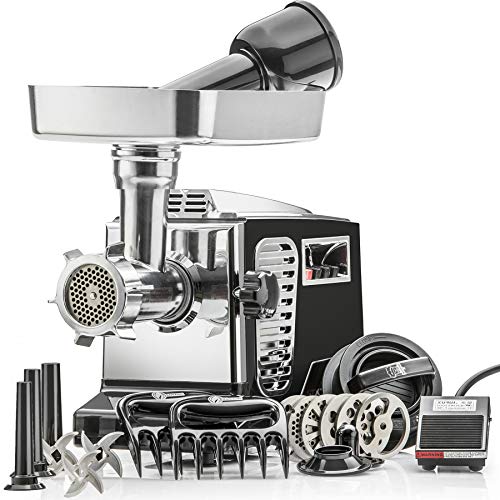
- Handles specified soft poultry and small-game bones
- Produces about 220–260 lb per hour
- Includes plates, sausage tubes, and foot pedal
Best For: Soft-bone grinding with broad accessory needs
Adjustable Pet-Food Bone Grinder
Huanyu 1.3HP Variable-Speed Bone Grinder

- Handles poultry, ribs, and small-game bones
- Five-speed touchscreen with reverse function
- Includes three plates and pet-food accessories
Best For: Pet food and moderate-batch adjustable grinding
Top Heavy-Duty Pick
#32 Commercial Electric Meat Grinder

- 2.0 HP, 1500W motor rated up to 705 lb/hour
- Stainless steel build with reverse function
- Grinds chicken bones for pet-food preparation
Best For: High-volume kitchens, farms, hunters, and pet-food batches
Best Proven Home-Commercial Balance
LEM BigBite #22 Bone-Capable Grinder

- 1.0 HP motor rated up to 13 lb/minute
- Handles raw chicken bones and game meats
- Includes three plates and sausage accessories
Best For: Home kitchens, hunters, and medium-to-large batches
Best Compact Value
Newhai 1.3HP Commercial Bone Grinder

- 950W, 1.3 HP motor rated up to 370 lb/hour
- Handles soft chicken and fish bones
- Compact 46-pound stainless steel design
Best For: Small restaurants and countertop soft-bone processing
High-Capacity Workhorse
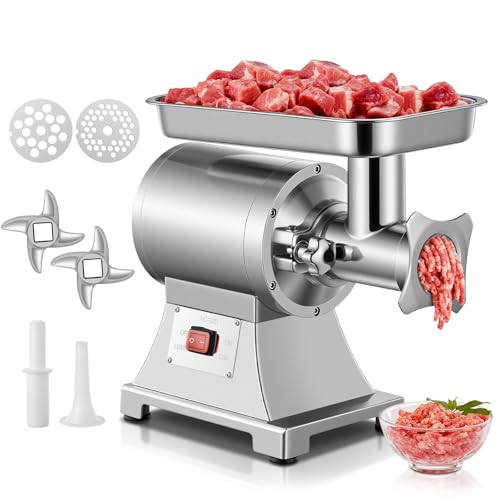
- Processes up to 330 pounds per hour
- Stainless-steel food-contact components
- Includes two plates, two blades, and sausage tube
Best For: High-volume meat and vegetable grinding in commercial kitchens
Maximum Listed Throughput

- Listed capacity reaches 661 pounds per hour
- Includes 6 mm and 8 mm grinding plates
- Gear-driven motor with air-cooled fan
Best For: Large batches and flexible meat, fish, and vegetable processing
Bone-Use Specialist
Anatole 1300W Commercial Mincer

- Specifically mentions chicken and fish bones
- 1300W motor with cooling system
- Six plates, four blades, and sausage stuffer included
Best For: Chicken or fish bones plus regular meat grinding
High-Volume Poultry Bone Crusher – 200–230kg/h Commercial Bone Crusher
For buyers seeking a commercial meat grinder for bones, this 2200W machine is designed for high-throughput processing of chicken, duck, fish, lamb, pork, and similar ingredients. Its screw design, large feed opening, casters, discharge tray, and emergency stop support faster one-person operation. However, it is not intended for beef or other very hard bones.
Best For: High-volume processing of poultry, fish bones, and softer animal ingredients for feed or food preparation.
Pros:
- Rated for approximately 200–230 kg of output per hour.
- Thick coated cast-iron body with stainless steel hopper and safety cover.
- Casters, catch tray, and emergency stop switch improve usability.
- Longer feed path and spacious 10 × 12.8 cm opening support efficient loading.
Cons:
- Cannot be used for beef bones or other especially hard bones.
- Ingredients must be cut into small pieces before grinding.
- Running empty for too long may damage the blades.
This is a strong throughput-focused option when your operation mainly handles poultry or fish bones. Its stated capacity is impressive, but buyers processing hard mammal bones should choose a machine specifically rated for that task.
Heavy-Duty Meat Processing Pick – FOHERE #22 1100 lb/h Commercial Grinder
This FOHERE #22 is a practical commercial meat grinder for bones when your priority is high-volume meat preparation with some flexibility for softer ingredients. It offers up to 1100 lb/h, supports four hours of continuous use, and includes reverse operation, but the supplied specifications do not explicitly rate it for bone grinding.
Best For: Restaurants and food-processing operations that need fast meat grinding, sausage stuffing, and easy routine cleaning.
Pros:
- Processes up to 19 pounds per minute with four hours of continuous-use support.
- Full stainless steel construction resists rust and supports commercial durability.
- Reverse function helps address jams during operation.
- Includes 6mm and 8mm plates, two blades, and a sausage stuffing tube.
Cons:
- Bone-grinding capability is not specifically stated in the supplied product information.
- Accessories should not be cleaned in a dishwasher.
- Requires prepared meat to be loaded into its large hopper.
Choose this model for commercial meat throughput and versatility rather than as a dedicated bone crusher. Its stainless body, reverse function, and included stuffing equipment make it well suited to general processing workflows.
Soft-Bone Grinding Package – STX Turboforce II 4000 Soft-Bone Grinder
The STX Turboforce II 4000 is a versatile commercial meat grinder for bones when the task involves soft bones such as chicken, rabbit, squirrel, or quail. Its size No. 12 format, air-cooling system, foot pedal, and broad accessory package make it suitable for frequent grinding and sausage-making work.
Best For: Users who need soft-bone grinding plus multiple plates, sausage attachments, and hands-free foot-pedal operation.
Pros:
- Specifically stated to handle soft bones from chicken, rabbit, squirrel, and quail.
- Advertised output of approximately 220–260 lb per hour, depending on plate and meat type.
- Patented quad air-induction cooling and circuit breaker support extended operation.
- Includes six grinding plates, three blades, sausage tubes, kubbe tools, and meat accessories.
Cons:
- Bone capability is limited to soft bones rather than hard beef bones.
- The extensive accessory set may be more than basic grinding requires.
- The stated three-year guarantee applies only within the 48 continental states.
This is one of the more complete options for soft-bone processing and multipurpose home or small-operation use. Its extensive attachments add value, while the warranty limitations should be checked before purchase.
Adjustable Pet-Food Bone Grinder – Huanyu 1.3HP Variable-Speed Bone Grinder
For pet-food makers looking for a commercial meat grinder for bones, the Huanyu combines stated poultry, rib, and small-game bone capability with variable speed control. Its 1.3HP copper motor, touchscreen, stainless construction, and three plate sizes make it useful for adjusting texture while processing meat and bones.
Best For: Pet-food preparation, hunters, and compact kitchens that need adjustable grinding speeds and texture options.
Pros:
- Designed to grind most bones, including poultry, ribs, and small game.
- 1.3HP motor processes up to 4.4 pounds per minute and runs continuously for up to 60 minutes.
- Touchscreen provides five RPM adjustments plus one-touch reverse control.
- Includes 3mm, 5mm, and 7mm plates, sausage and kubbe kits, and dishwasher-safe cutting plates and blade.
Cons:
- The 4.4 lb/min rate is lower than the highest-capacity machines in this roundup.
- Continuous operation is specified for up to 60 minutes.
- Its compact 6.6-pound capacity may require more frequent loading for larger batches.
Huanyu is a balanced choice for controlled pet-food and small-batch bone grinding. Variable speed and multiple plates provide useful texture control, while the stated capacity makes it better suited to moderate workloads than industrial-scale production.
Top Heavy-Duty Pick – #32 Commercial Electric Meat Grinder
For shoppers seeking a commercial meat grinder for bones, this #32 model stands out for its 2.0 HP motor, stainless steel construction, and stated ability to process chicken bones. Its 1500W motor is rated for up to 705 pounds of meat per hour, making it suited to substantial batches.
Best For: Small farms, hunters, restaurants, and pet-food preparation involving chicken bones and other meats.
Pros:
- Powerful 1500W pure copper motor with a stated 705-pound-per-hour capacity.
- Food-grade stainless steel housing, tray, blades, and plates.
- Reverse function and removable auger help address clogging.
- Includes 6mm and 8mm plates, extra blades, and sausage-stuffing tubes.
Cons:
- At 108 pounds, it is substantially heavier than the other listed options.
- The included grinding plates are limited to 6mm and 8mm.
- Its large 21.85-by-13.78-by-22-inch footprint requires dedicated counter or floor space.
This is the strongest fit when bone grinding capacity, durability, and high-volume processing matter more than portability. The five-year warranty and lifetime support add reassurance for regular use.
Best Proven Home-Commercial Balance – LEM BigBite #22 Bone-Capable Grinder
The LEM BigBite #22 is a practical commercial meat grinder for bones when you want heavy-duty performance in a home-oriented package. Its 1.0 HP motor is rated to process up to 13 pounds per minute and can handle raw chicken bones along with common meats.
Best For: Home users, hunters, and cooks processing medium to large batches, game meat, sausage, or pet-food scraps.
Pros:
- 1.0 HP motor processes up to 13 pounds of meat per minute.
- Handles beef, pork, poultry, lamb, venison, and raw chicken bones.
- Stainless steel construction and noise-dampening design support regular use.
- Includes three plates, a knife, stomper, and sausage-stuffing tubes.
Cons:
- It has less motor power than the 2.0 HP model in this roundup.
- The product is relatively large at 18 by 19.5 by 17 inches.
- The notes do not specify the included plate hole sizes.
Choose this model for a balance of capacity, bone-handling ability, and manageable 49.6-pound weight. Its five-year factory warranty and lifetime customer support are useful advantages for repeat home processing.
Best Compact Value – Newhai 1.3HP Commercial Bone Grinder
If you need a compact commercial meat grinder for bones, the Newhai offers a 950W, 1.3 HP motor and a stainless steel body at a lower listed weight than the larger machines. It is designed to handle soft chicken and fish bones, with a stated efficiency of up to 370 pounds per hour.
Best For: Small restaurants and countertop users preparing meat fillings, sausage, and soft-bone mixtures.
Pros:
- Compact 46-pound design fits more easily on a kitchen counter.
- Handles soft chicken and fish bones as well as meat and vegetables.
- Includes 3mm, 6mm, and 8mm plates plus two blades.
- 304 stainless steel construction is described as rust-resistant and easy to clean.
Cons:
- It is intended for soft bones, not a broad range of bone types.
- Its 370-pound-per-hour rating is lower than the two larger grinders here.
- The warranty is one year, shorter than the five-year warranties listed for the other models.
This Newhai is a sensible choice where countertop size, included plate options, and moderate commercial output are priorities. Its bone capability is specifically limited to softer chicken and fish bones, so match it to that workload.
High-Capacity Workhorse – 1100W Commercial Meat Grinder
For buyers seeking a commercial meat grinder for bones and routine meat processing, this 1100W model emphasizes steady throughput, durable metal components, and straightforward cleanup. It is rated to process up to 330 pounds per hour and includes two blades, two cutting plates, and a sausage tube.
Best For: Kitchens, restaurants, butcher shops, and sausage shops that need high-volume meat and vegetable grinding.
Pros:
- 1100W pure copper motor with a listed capacity of up to 330 pounds per hour.
- Food-grade stainless-steel hopper plate, grinding head, and feed screw.
- Includes two cutting blades, two cutting plates, and a sausage tube.
- Designed for simple assembly, disassembly, and cleaning.
Cons:
- The supplied notes do not specifically confirm suitability for hard bones.
- At 40.3 pounds, it is substantial for frequent moving.
This is a practical high-output choice for standard meat mincing and sausage preparation. If bone grinding is your priority, verify the manufacturer’s approved ingredient limits before use.
Maximum Listed Throughput – VEVOR 800W Heavy-Duty Mincer
This VEVOR machine is worth considering when a commercial meat grinder for bones search also includes high-volume meat processing. Its 800W motor is listed at up to 661 pounds per hour, while the gear-driven design, cooling fan, two grinding plates, and sausage kit support continuous kitchen tasks.
Best For: Home kitchens, hotels, restaurants, and other users prioritizing high stated throughput and coarse or fine grinding options.
Pros:
- Listed grinding capacity of up to 661 pounds per hour.
- Includes 6 mm and 8 mm grinding plates for different textures.
- Steel gear-driven mechanism and air-cooled fan support steady operation.
- Handles meat, fish, chili, vegetables, and sausage filling.
Cons:
- The notes do not state that it is approved for grinding bones.
- At 42 pounds, it is relatively heavy and has a large footprint.
Its standout feature is the unusually high listed capacity, making it appealing for demanding batches. Treat bone use as unconfirmed unless the manufacturer provides specific guidance.
Bone-Use Specialist – Anatole 1300W Commercial Mincer
Among these options, the Anatole most directly addresses a commercial meat grinder for bones use case because its notes specifically mention chicken and fish bones. Its 1300W motor, multiple plates, four cross blades, cooling system, and removable grinding components make it versatile, but the manufacturer excludes beef bones, pork bones, and other overly hard ingredients.
Best For: Users processing meat, vegetables, chicken bones, or fish bones while avoiding hard beef and pork bones.
Pros:
- Notes explicitly mention suitability for chicken and fish bones.
- 1300W, 1.8 HP motor with an advanced cooling system.
- Includes six grinding plates, four cross blades, and a sausage stuffer.
- Removable food outlet and auger help clear blockages and simplify cleaning.
Cons:
- Not intended for beef bones, pork bones, or other very hard ingredients.
- Some aluminum components are recommended for hand washing.
- The supplied details list conflicting voltage information, so confirm compatibility before buying.
This is the clearest match for limited bone grinding, provided you stay within the stated ingredient restrictions. Its broad accessory set also suits meat, vegetable, and sausage-making tasks.
How We Picked the Best Commercial Meat Grinder for Bones
We focused on the specifications that matter most for demanding grinding jobs: motor power, stated hourly capacity, compatible bone types, construction, grinding-plate options, reverse functionality, and included accessories. We also considered whether each model is better suited to occasional heavy use, regular commercial work, pet-food preparation, or animal-feed processing.
Capacity figures are manufacturer estimates and can vary with the meat-to-bone ratio, ingredient temperature, cut size, feed rate, and plate configuration. A machine advertised for soft bones should not automatically be treated as suitable for large, dense, or weight-bearing bones.
Quick Comparison
| What to Compare | Why It Matters |
|---|---|
| Motor power | Higher power generally helps maintain performance under heavier loads. |
| Rated throughput | Shows the approximate processing capacity, though real-world output varies. |
| Bone compatibility | Confirms whether the grinder is intended for soft bones, poultry bones, or dedicated crushing. |
| Plate sizes | Determines texture and supports different recipes or feed applications. |
| Reverse function | Helps clear jams without immediately disassembling the grinder. |
| Construction | Stainless-steel components and robust housings are preferable for frequent use. |
Key Buying Factors for a Commercial Meat Grinder for Bones
Motor Power and Realistic Capacity
Look beyond horsepower claims and consider how the grinder performs under continuous load. A high advertised pounds-per-hour rating is useful only if the unit can sustain it without overheating or frequent pauses. For regular bone processing, choose a model with reserve power rather than sizing the machine exactly to your average batch.
Bone Type and Feed Preparation
Bone grinders differ substantially. Some handle soft poultry, fish, or small animal bones, while dedicated bone crushers are designed for animal-feed applications. Cut ingredients into appropriately sized pieces, follow the manufacturer’s restrictions, and never assume a standard meat grinder can safely process dense leg or weight-bearing bones.
Plate Options, Reverse, and Controls
Multiple grinding plates make it easier to produce coarse, medium, or fine results. A reverse setting is especially useful when connective tissue or bone fragments slow the auger. Foot pedals, simple switches, and overload protection can also improve workflow during larger batches.
Cleaning, Safety, and Service
Removable food-contact parts should be straightforward to wash and dry thoroughly. Check that blades and plates are replaceable, electrical requirements match your workspace, and the machine has stable feet or a secure base. Follow sanitation procedures carefully when processing raw meat, and use protective equipment when handling sharp plates and blades.
Who Should Buy Which Commercial Meat Grinder for Bones?
Choose a dedicated bone-crushing machine if you process poultry, fish, or small animal bones for feed in substantial volumes. Choose a #22 or similarly heavy-duty grinder for mixed meat batches, pet-food preparation, and frequent home or small-business use. Choose a higher-powered commercial model when throughput and reduced stoppage time matter most. Choose a simpler lower-capacity unit if bone grinding is occasional and your main task is processing boneless meat.
Before ordering, verify the allowed bone size, duty cycle, voltage, outlet requirements, warranty, replacement-part availability, and whether the listed capacity applies to meat only or to bone-containing mixtures.